Losing My Dad to ALS: Our Relationship and His Last Days
My father passed away a few weeks ago. In this article, I reflect on his battle with ALS, our relationship, his last days, and the transformations that helped me through this period.
Contents
Intro
Past few years since his diagnosis
My early relationship with my dad
Seeing my dad in his totality
Transformation in relationship with my dad
Limitations I faced in evolving our relationship
His last year and a half
His last days in the hospital
His cremation ceremony
The aftermath
Reflections
Where I go from here
Intro
As I stood in the high dependency unit room in the hospital in Singapore, next to my dad lying in bed with a hundred different wires and devices connected to him, he communicated the words, “I’m ready to die. Let me go.” Tears just poured out of me as I sobbed uncontrollably. Grief just coming out from deep in my body. My dad had never said those words before, and so I knew this was it. It reminded me of how much love and feeling we hold in our bodies that we aren’t conscious of.
Past few years since his diagnosis
The past three and a half years since my dad was diagnosed with ALS have been both challenging and some of the most transformational of my life. In the first couple of years after he was diagnosed, I grieved. Even though my dad had not passed yet, I knew his time was limited, and it unearthed deep feelings and reflections.
I would sit in my room, staring out the window, listening to an old Italian song, Il cielo in una stanza, and cry for hours. It brought back so many memories of our times together. But more than memories, it was a feeling. A feeling of losing a deep source of dependency and comfort that I could rely on. I remember feeling that without my father, I was going to be more alone in this world.
I guess I was blessed to have my parents live this long, and some others aren’t so lucky. And so I took for granted the solace of always having someone I could depend on, no matter what happened to me. Someone I knew I could run to in a heartbeat, at any moment, and they would embrace me, take me in, and care for me until I was better. Feeling that slip away hurt deeply.
My early relationship with my dad
The thing is, my dad and I never really saw eye to eye. We were always very different people. He didn’t always agree with my life choices. We wanted to talk about different subjects. I wasn’t very interested in his subjects, and he wasn’t very interested in mine. We were always slightly at odds with each other.
Growing up as a kid, I revered my dad. Spending quality time with us was really important to him. He taught me how to ride a bike, played ping-pong with me for hours on end, and watched Indian mythological classics like the Ramayan and Mahabharat in Hindi, patiently translating line by line for my sister and me as we watched. He’d play chess with me, sing, and tell me stories. He taught me financial responsibility, life structure, morality, and the ways to succeed in our world.
He worked hard to pay for my education. He grew up in a small village in India, and it was a tough journey to the kind of career success he went on to have in Hong Kong and Singapore. I admired his sharp intellect and work ethic.
Seeing my dad in his totality
As I grew older, into my late teens and especially my early 20s, my values shifted. I began to awaken to my true self. The illusion of my dad being a role model broke. I awakened to the ways I didn’t want to be like my dad.
I connected with my repressed anger and sadness from my relationship with my dad. Anger at the way he treated me sometimes, at the way he was often trying to mold me into an image of what he wanted for me, as opposed to seeing me in the totality of my true nature and supporting me in nurturing it. Sadness at never feeling fully seen by my dad.
I realized through deep feeling that I had brushed feelings under the rug for most of my childhood and 20s. And it ate away at my relationships in subtle ways and created disconnection instead of deeper connection. People often judge themselves for these feelings, especially towards their parents and loved ones, and thus never allow themselves to fully feel them.
Doing transformative work around this for years unveiled an even deeper love than I ever had for my father. And my mother. And it deepened our connections. It taught me the power of healing.
It gave me grace for my parents, seeing them as the ordinary humans they are, just like myself, figuring out how to best raise kids.
I also learned that understanding all this intellectually isn’t enough. You have to allow yourself to feel it in your body, and that’s when the healing and expansion of emotional capacity happens. Otherwise it stays intellectual, and it doesn’t transform our being. For me, the most life-changing transformation has happened through the body.
I realized that my dad didn’t value connecting with his feelings. He didn’t value sharing his feelings. He didn’t value vulnerability with friends and family as a way to deepen connection.
Although my dad didn’t express love verbally, he acted in love. Seeing this more clearly allowed me to feel his love more directly through his actions.
He didn’t value listening to his body. In his own words, he used to say, “My mind tells my body what to do and it just does it. It’s a one-way relationship.”
He rejected the idea of therapy. He didn’t see value in integrating his shadow. He saw the need for therapy as a sign of weakness.
What I’ve learned going through therapy, and doing advanced transformative work with coaches beyond therapy, is that it makes us stronger, not weaker. We no longer need to hide from anything within us. We can handle anything life throws at us. And we can create more connection all around us.
I disagreed with his desire not to share his ALS diagnosis with many of his friends. In a world with so much isolation, I value connection, and this went against my values.
Transformation in relationship with my dad
In 2019, I proposed to my dad that we take a month-and-a-half trip to Africa, just the two of us. My intention was to create a deeper bond with him.
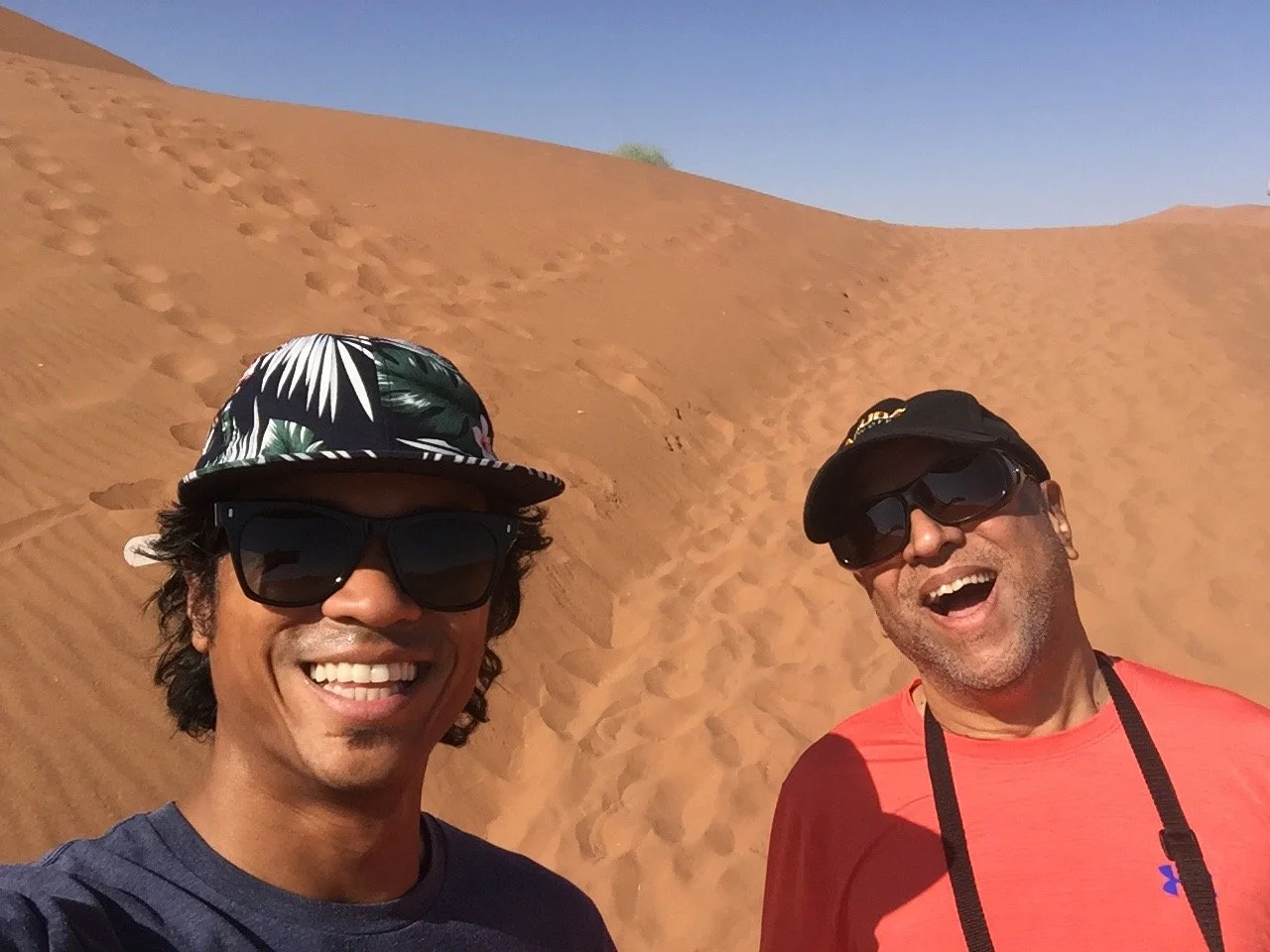
My Dad and I climbing the sand dunes in Sossusvlei, Namibia
The trip was transformative for both of us. Sure, what we saw was incredible. We got to meet the Batwa people on the outskirts of the forest in Uganda, see National Geographic–worthy wildlife, stay overnight in a Hamar tribe village in Ethiopia, climb the sand dunes of Namibia, and even have a close call with a dominant male silverback gorilla charging at us.
But more importantly, we got to actually be vulnerable with each other. I had never seen my dad be that vulnerable with me. He shared how he felt, and I told him how I felt about him.
Both of us came out of that trip reflective about who we were as people. Our relationship shifted after that, and I saw how my dad’s perspective of me had shifted. He saw me less in his own image, and more as an adult whom, although he didn’t fully understand, he respected.
In 2022, when I was living in Kona, on the Big Island of Hawaii, he came out to visit me. It felt like he was participating in my life for once, as opposed to me in his.
Limitations I faced in evolving our relationship
As much as I wanted an even deeper relationship with my dad, a more vulnerable one, one where he shared more about his feelings with me, his pain, his regret, I couldn’t get him to go there. As a practitioner of deep emotional and vulnerable conversations, I felt hurt, disappointed in my dad, and disappointed in myself that I couldn’t get him to open up as much as I wanted him to.
Especially because I could feel the pain in him. I knew there was sadness, repressed feelings, trauma. I could feel it. I could see it show up in his body, on his face, in his words. Just as I had in my own life, and had to heal. And I knew that there was more love, self-love, freedom, joy, and peace waiting on the other side for him.
It was an important lesson for me to learn to love him exactly as he was, without compromising my own authenticity and integrity. I continued to invite my dad to be vulnerable with me, and shared how I felt about things in my life. I started to see the world through his eyes, and understood why he didn’t want to open up more.
His last year and a half
In the last year and a half of his illness, he progressively went from being able to make some tiny movements, and having some mobility when he was moved from the bed to a wheelchair for walks, to being bedridden and increasingly reliant on a ventilator.
As his speech had gone, he was using an eye tracker to communicate. He stopped eating food and was fed through a PEG tube. It was hard to see him go through this, to gradually lose more and more of the things that brought him joy in life.
And as time went on, his ability to use his eye tracker diminished, as did his ability to breathe.
His last days in the hospital
The last 10 days of his life were spent in the hospital. In September 2026, I got an urgent call from my mom saying that my dad had just been rushed to the hospital, and she felt it was really serious. Although I had been mentally prepared for this to happen at some point, I was overcome by panic and fear that I wouldn’t be able to see my dad one last time before he died. I booked the first flight out to Singapore, leaving in a couple of hours.
Thankfully, I arrived in time. I remember the look of surprise on my dad’s face when he saw me walk in, as I had just spent a few weeks with him in July.
Initially, it felt hopeful. He seemed to be showing signs of recovery, although it was clear that even if he went home, it was a matter of weeks or months at most before he would be back in the hospital.
Sitting at his side from morning till night at the hospital, I was thankful for all the transformation work I had done in the past eight years. It supported me through this process.
Growing up as a kid, I suppressed my feelings and hid them, just like my dad did. But through the transformation work I had done, my feelings were readily accessible. And this was crucial at this time. I needed to be there, not just for him, but for my mom and my sister as well.
Being able to feel deeply has given me the strength to take on anything in my life. Knowing that nothing can break me. As I sat there by his side, I embraced all the sadness, anger, and grief. I let it out.
When conversations with doctors about his situation left me feeling anxious and short of breath, I relied on my breathwork practices to deepen my breath and restore my embodiment. In those moments, what I needed wasn't to think or even to feel my way through. It was simply to breathe.
I relied on movement and dietary practices to sustain my energy levels and restore my sense of vitality, as it was getting depleted daily from the emotional exhaustion. I allowed myself to rely on support from family. Their presence really helped.
During this time, we had to rely on new communication techniques with him, like reciting the alphabet one letter at a time so he could spell out words. This was critical so that we could honor his last wishes.
I’m thankful for years of practicing non-distractedness. Being fully present at this time allowed me to care for him more closely.
It was challenging dealing with the constant decisions we had to make, while trying to understand his current state from the doctors. I got to see firsthand the challenges patients and families face with the healthcare system at this stage. I saw how some doctors were trying to get him discharged, while more senior doctors approached the situation with greater sensitivity. My understanding is that they face pressure from limited hospital beds. I’m told it’s similar in the United States. As you can imagine, I was much more concerned about what was best for my dad.
But after about seven days in the hospital, he declined rapidly. He had a couple of close calls. It was painful for me to see him suffer with each breath. At this point, he communicated to us, “I’m ready to die. Let me go.”
What happened next was something I did not expect. I had done so much grieving in the past three and a half years, cried so many tears, and was so mentally prepared for this to happen at some point. Yet when I heard those words from my dad, tears just poured out of me and I sobbed uncontrollably. I knew this was it.
It reminded me of just how much love and feeling is stored unconsciously in our bodies. Despite eight years of deep, intense transformation work, including embodiment, somatic, and emotional work, there was still more in my body that I wasn’t aware of.
I’m grateful that I was able to access it at that moment. It made all the difference that I was able to let myself sob, and to be fully present to what was happening.
I’m grateful that we were able to use alternative communication techniques with him during his last three days, so that we could honor his last wishes. And I’m glad he was able to leave us peacefully and painlessly.
His cremation ceremony
Although I’m not religious, I was proud that I was able to give my dad a Hindu cremation, as per his wishes, and to honor him at the ceremony with a speech. Seeing all the people gathered there made me reflect on his years of community work and the impact it had on people’s lives.
When I gave the speech, I cried. Humbled by his journey, and his impact.
As a kid and in my 20s, I was closed to expressing feelings this way in public. I’ve learned over the years that vulnerability creates connection. In letting go of my shame around this, I allowed myself to show up authentically. And honestly.
The aftermath
I had my flight booked back to the US after the ceremonies were done. I woke up in the middle of the night with a feeling that my mother needed me to stay, and postponed my flight. It made all the difference to her to have me by her side in the days after. And by the time I left, she was feeling lighter once again.
I’ve learned over the years how to give myself grace. To honor my feelings, and those of others, even if our instinct in our high-achieving, go-go-go society is to brush them aside in favor of more doing. Balancing the human being and the human doing. It makes all the difference to the people in our lives when we show up for them.
Reflections
Looking back, I’m grateful for so much. Grateful for all the time we spent together. For the transformative trip to Africa. For being able to spend time with him after his diagnosis. For being able to be there with him for his last days. Grateful that I had him as my father.
Grateful for all the transformative work I’ve done over the past eight years: the somatic, embodiment, nervous system work, mental health, shadow and emotional work, bodywork, health, and spiritual work.
Together, they helped me transform my relationship with my father, with myself, and with my family. They helped me be fully present for his last days. To have clarity on what I value, and to make the choices I did to be there with him.
To have the vulnerability and capacity to be there for my mom in the days after, and help her through it as well.
To feel at peace with what happened. And to be able to help other families in the ALS community as well.
This is the way of being I always dreamt of. A deeply vulnerable one. One that embraces sadness, happiness, and everything that happens to us as part of the great journey of life.
Where I go from here
I remember thinking during my dad’s cremation ceremony that I wanted to do even more for others than I have thus far.
I recorded a video tutorial for the ALS community on communication techniques for late-stage ALS patients. I was taken aback by the gratitude from the community. It made me even more motivated to do more for others.
I’m humbled at the thought of how selfless many people in this world are, and how much more I’d like to be like them.